
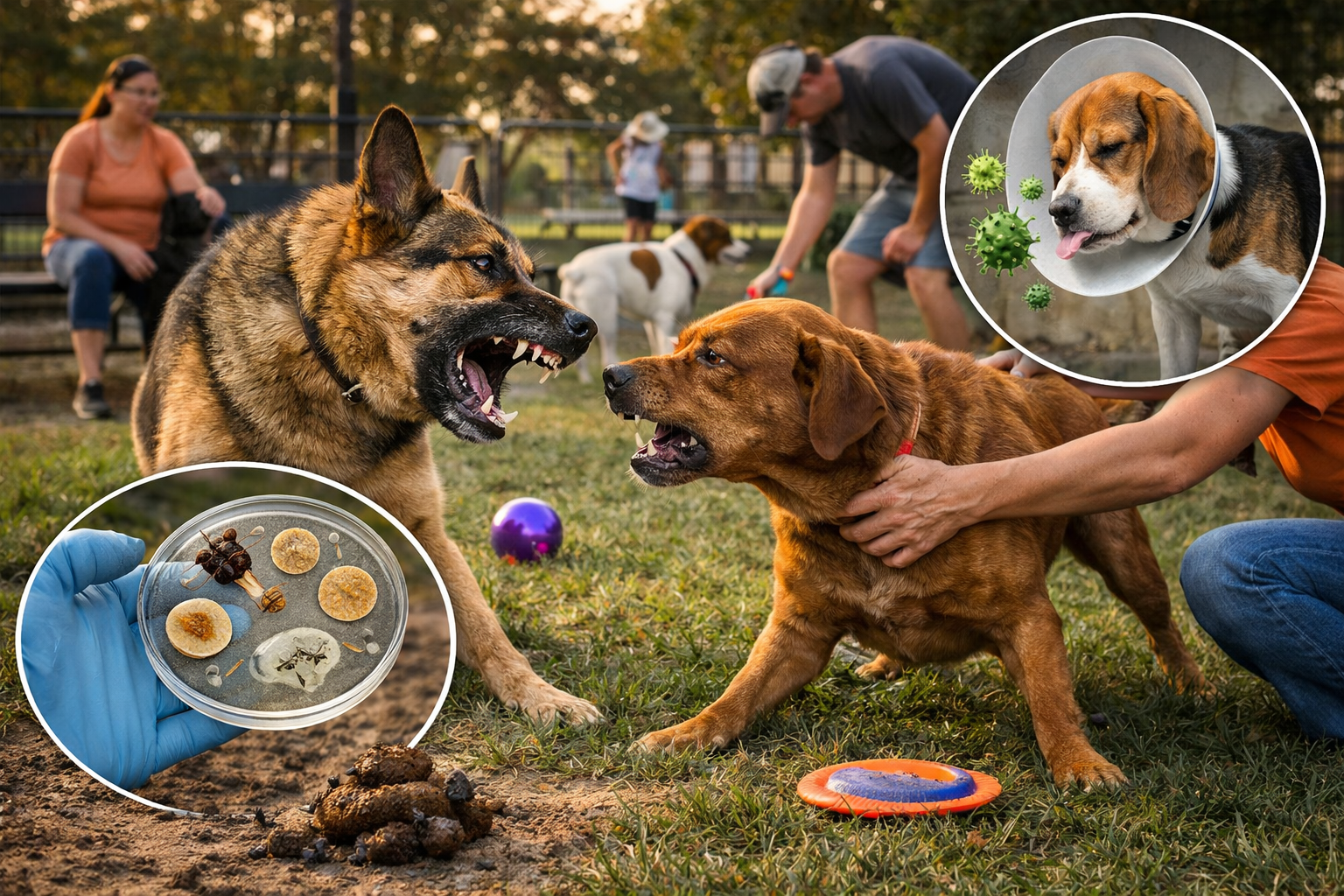
The slogan for Las Vegas is: What Happens in Vegas, Stays in Vegas. That may be true for Las Vegas, but it is not true for dog parks. Although dog parks may offer play time / social interactions for both you and your dog, it may come with a high price. Injuries, antisocial behavior, illness and parasitic infections are just a few unfortunate things that may happen at a dog park.
Unfortunately, injuries seem to go hand in hand with dog parks. Dog fights are the typical cause because some people who have an aggressive dog seem to believe that ‘socializing’ their dog unleashed at a dog park will be a quick fix. Sadly, it only leads not only to physical injuries, but these ‘victim’ dogs can sometimes be so traumatized that they become aggressive towards other dogs, fear biters, or are terrified of new situations. At times, a dog may not be injured at a dog park, but the owner may be injured trying to protect their dog from an aggressive dog or trying to control their own dog who may be excessively pulling on his/her leash prior to release.
The saying goes – Parvo Paints the World – is very true at dog parks. Parvo is virus that attacks rapidly grow cells of the body – especially the lining of the intestinal tract. Treatment consists of supportive care while the infected dog heals their intestinal lining. Prevention against Parvo virus is based on how well your dog is vaccinated against Parvo. Respiratory infections can be easily spread at dog parks not only through nose to nose contact but sharing communal water bowls. There are about twelve different viruses and bacteria that can cause upper respiratory infections. We only have vaccines for four of them.
The more frequent you visit a dog park, the more likely your dog will come in contact with one of these viruses or bacteria, especially during our busy winter season. The sad fact is many people do not understand that when their dog’s symptoms from an infection have stopped, be it a respiratory or intestinal virus or bacteria, that individual will continue to shed the infectious particles into the environment for up to a month after recovery. For example, if an animal who had an infectious cough returned to dog park activities when their cough resolved after 5-7 days, that animal will continue to shed infectious particles into the environment, thereby infecting other dogs in the park. A more serious concern are viruses that can survive in the environment for up to 24 hrs, like influenza virus. This means after a recovered animal who prematurely went to a dog park leaves, the infectious particles that they inadvertently shed into the environment can survive on surfaces for up to 24 hrs. Parvo virus can be shed in the stool of recovered dogs for up to a month, even though they have normal appearing stool! Since we do not have long, cold winters, Parvo virus can live for months to a year or, under ideal environmental conditions, up to nine years! Parvo virus can survive on soil, concrete, clothing and metal surfaces like bowls.
Similar issues are seen with intestinal parasites. Many owners think that if their dog has normal stool and they can not see any worms in their dog’s stool, they do not have intestinal parasites. However, the eggs that intestinal parasites shed are microscopic, except for tapeworms. Hookworm eggs can last for months. Hookworms thrive best in warm, sandy, damp soil, which are the ideal conditions all summer in Florida. Another common intestinal parasite is Roundworms. The eggs from this parasite are very hardy and can survive severe environmental extremes from heat to cold for weeks to decades and longer. According to the National Institutes of Health, a 46,000 year old roundworm was revived from Siberia. Giardia is a protozoan intestinal parasite that is immediately infectious when passed in the stool of an infected dog. Infected dogs will typically have greasy, foul smelling diarrhea but there are some dogs that act as an asymptomatic carrier. An infected animal can have normal stool but be actively shedding cysts into the environment. Giardia cysts survive best in moist, shaded areas but can be killed by direct sunlight, heat and drying agents. Hookworms, Roundworms and Giardia are tough parasites that not only can infect your dog, but can infect people, too. Regular fecal evaluations of your dog and avoiding heavily contaminated areas are key to reducing parasitic infections for your dog and your family.
In conclusion, dog parks look like a great outlet for exercise and socialization for both you and your dog. However, there are many hidden down sides of visiting dog parks like dog fights, injuries, spread of infectious diseases, and intestinal parasites. As an alternative, consider leash walking your dog on paths, downtown areas, or the local mall. You can organize dog play dates with friends where all the dogs have been previously introduced and have known, friendly temperaments. Pool parties, play dates in a friend’s fenced yard, group obedience or agility training are all safe ways to socialize with your dog.
Our local veterinarians at Town and Country Animal Hospital are knowledgeable about the common diseases and illness we see in the surrounding areas of Naples, Bonita, Estero and Marco Island area. We believe in educating owners about heartworm, flea and tick prevention as well as guiding owners in making the best decisions for their pet dependent on its lifestyle. Appropriate preventative medications can be dispensed to our clients directly from our inhouse pharmacy or through our online pharmacy at https://mynaplesvet.covetruspharmacy.com